Young Americans – Ryan Bock’s Patriotic Parody
Written by T.K. Mills
Photos by Andy Zalkin & Jake Borden
Published on August 8th, 2026
What does it mean to be an American, in an era defined by values antithetical to our espoused ideals? Who can be a patriot in a country that questions its citizens based on their skin color? How does one celebrate the founding of our nation, when our nation leads another illegal war with no clear objective? These are some of the questions I found myself asking upon visiting Ryan Bock’s Young Americans exhibition.
I first met Bock in 2018 when I was still in my freelancing days and he was only a few years out of Chicago. By happenstance I sat next to him at the now-defunct bar Father Know’s Best and struck up a conversation after noticing the paint splattered on his jeans. When visiting his studio weeks later, I wrote a profile on his body of work, which at the time centered around black and white cubist pieces. After launching UP, the magazine covered his Somnambulist show in 2019 and we kept in touch loosely over the years, as I’d see him at shows dressed down with a black ski mask.
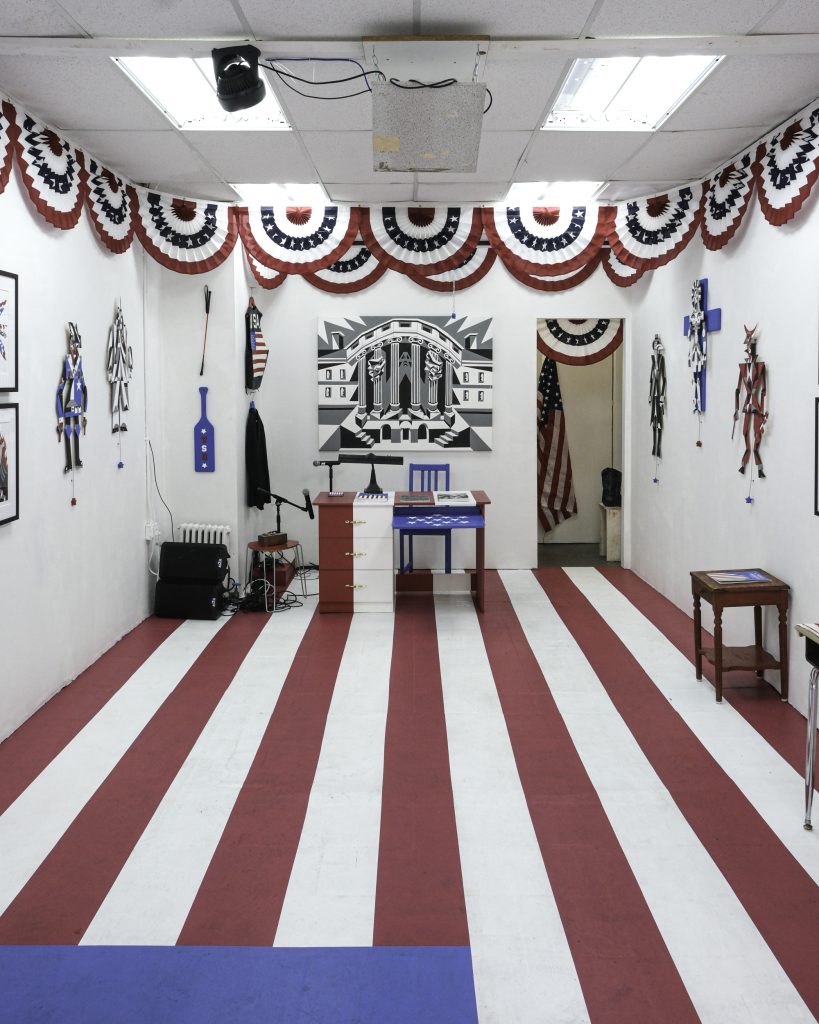
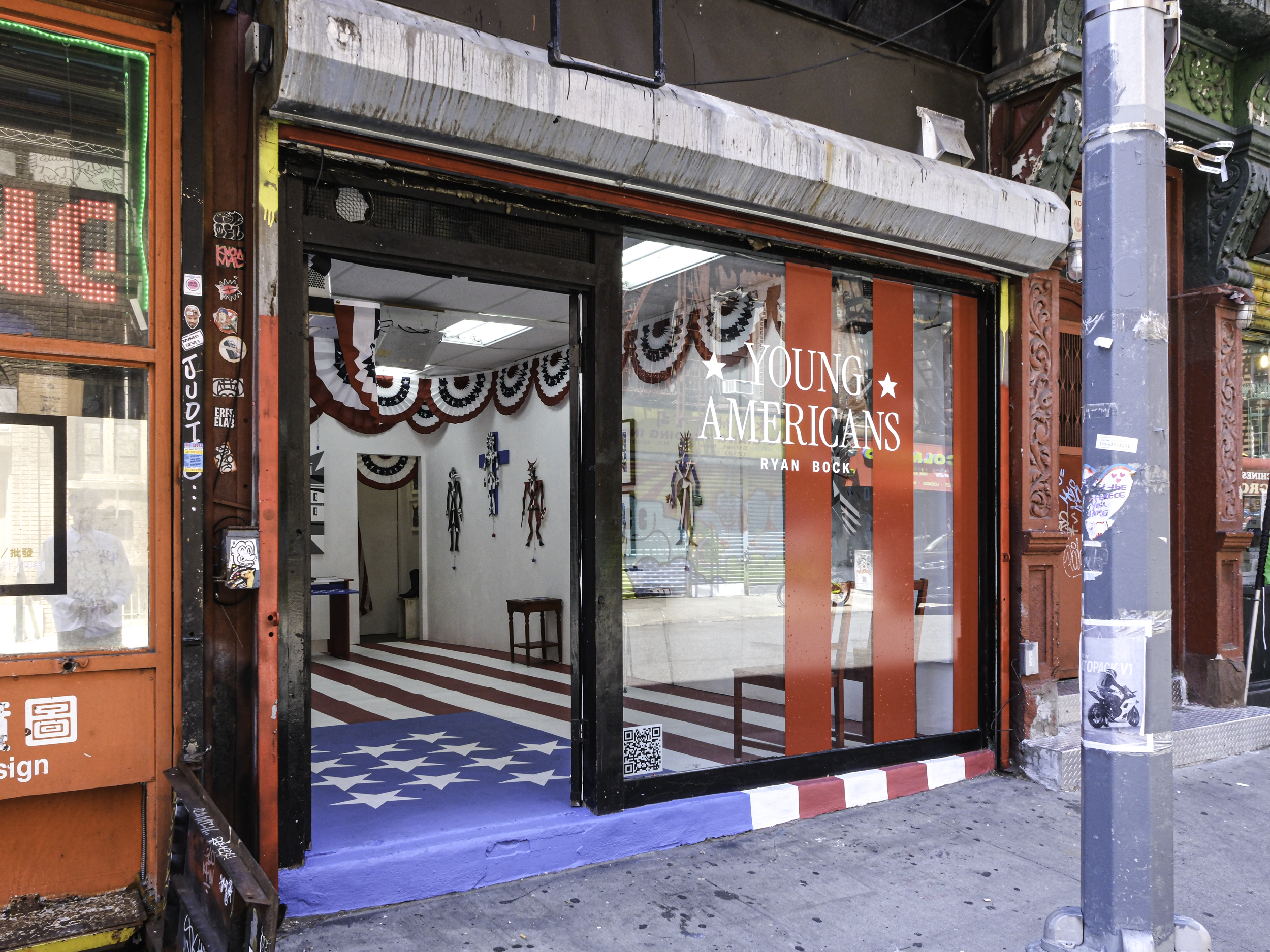
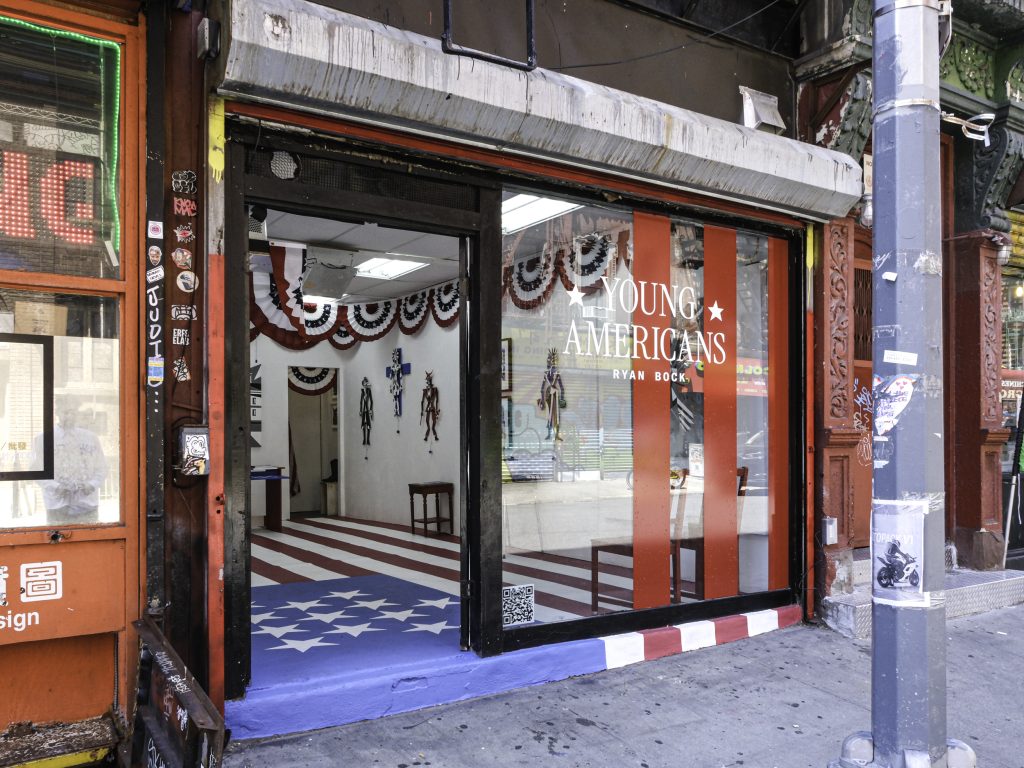
So, I was surprised when arriving at the exhibition to find him dressed in a suit and unmasked, surrounding by red, white, and blue regalia. Opening on the 4th of July, the month-long show parodied the maximalist decor associated with patriotic spirit, the Stars and Stripes painted across the floor, pleated flag buntings hanging from the ceiling, and complete with hot dogs being served to the community. Like most passersby, I was confused – but confusion invites curiosity.
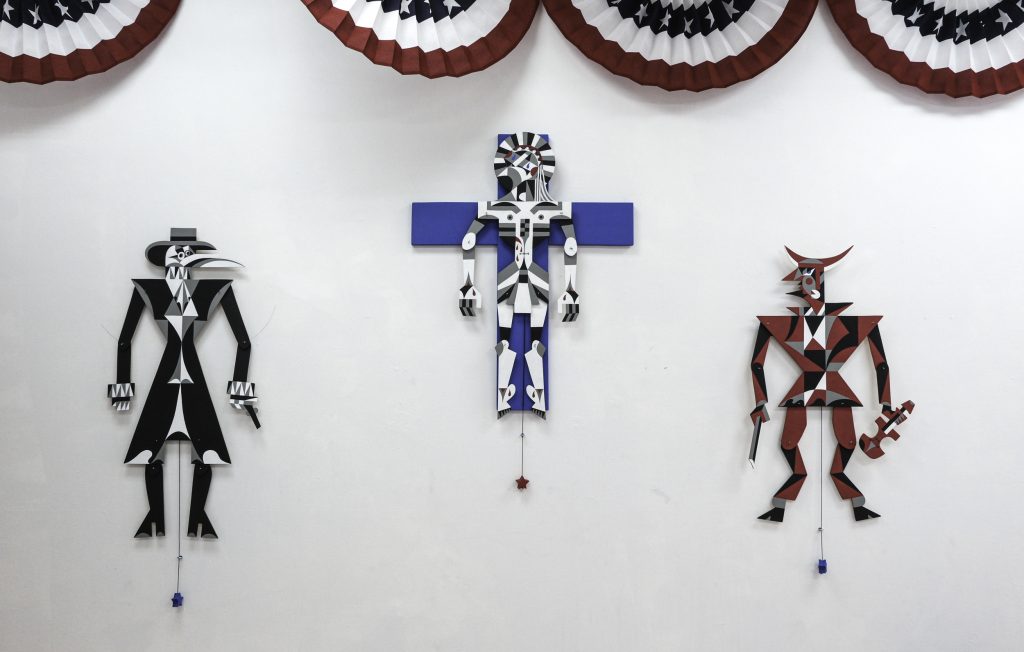
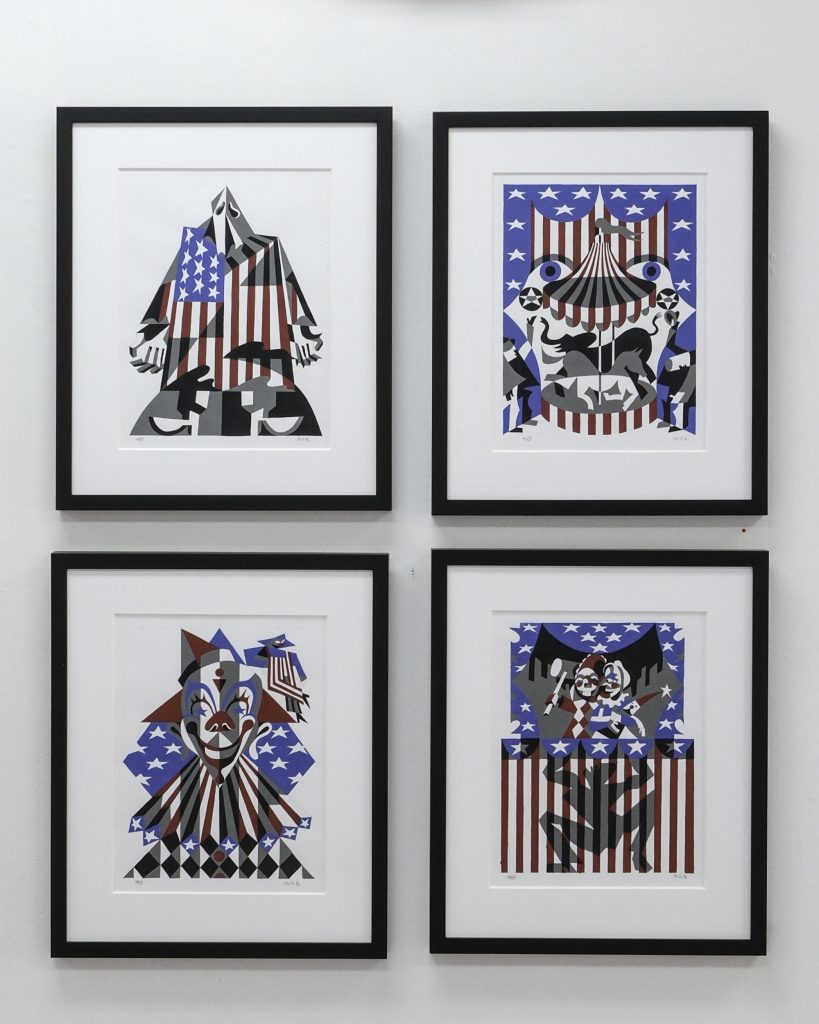
Young Americans explored the disconnect between the significance of the Semiquincentennial holiday whilst the nation is governed by the most explicitly corrupt president in its history – through a range of multimedia works and a variety of perspectives. The art takes the shape of puppets, complete with strings for guests to pull and make them dance, as parodies of American symbols, ranging from pilgrims, Klansmen, lady liberty, and patriots. The collection runs the gamut from the most celebrated to the most despised symbols of American history. Beyond the marionettes, there were canvases, original works on paper, and even a cake depicting eagles, founding fathers, and other elements of American iconography.
“This satirical celebration of the 250th anniversary is trying to incite conversations that we’re actively being discouraged from having,” Bock explained, noting an aversion from the traditional gallery world to touch on the deeper meaning of the holiday whilst a man who incited a riot against the capital sits in the Oval Office. However, Bock has never been one to back down from a contentious stance. For Bock, avoiding controversy means avoiding substance.
The art takes the shape of puppets, complete with strings for guests to pull and make them dance, as parodies of American symbols, ranging from pilgrims, Klansmen, lady liberty, and patriots. The collection runs the gamut from the most celebrated to the most despised symbols of American history.
Portions of the series had previously appeared in smaller presentations, but Young Americans marks the first time the complete body of work has been shown as a unified project. An earlier version of the exhibition had been intended for a gallery in Los Angeles before being canceled, and the New York iteration was originally conceived as a broader mini-retrospective spanning more than a decade of politically engaged work. Time, cost, and location led him to narrow the vision into what would become Young Americans.
One of the challenges with putting the show together was finding the right venue – at one point he was even in talks with the fake Banksy museum on Canal Street, given the tongue-in-cheek nature of the exhibition, though ironically it was too controversial. “As if anything I was doing is crazier thank Banksy,” Bock said. Eventually the stars (and stripes) aligned when he connected with artist and Satellite Art Show founder Brian Andrew Whiteley, whose artist-first approach aligned with the exhibition’s unruly spirit. Bock knew of Whiteley from Chicago, where the latter’s taste for the eccentric included performing as a clown in cemeteries. Whiteley took to the idea and gave Bock the space to direct his vision at the Satellite Art Show Gallery.
Though the exhibit shifted away from a retrospective, it still carried recurring elements of Bock’s oeuvre. Young Americans references David Bowie, continuing a thread from Bock’s 2018 Paris exhibition I’m Afraid of Americans. While the earlier title leaned directly into apprehension, the new name carried a more hopeful, if ironic, charge.
“I tend to be perceived as a pessimist,” Bock said. “So I was like, Young Americans—there’s something about it. Hopefully this show serves a call to action to bring people together, to organize and start these conversations.”
The title also places America’s age into perspective. At 250 years old, the United States remains a relatively young nation compared with many other countries and civilizations. “We are all, no matter our age, young Americans,” Bock said. “We’ve been around for 250 years. The chaos that’s happening in the country feels overwhelming, like we have no power. In actuality, we as young Americans, have all the power and can create a new system that works for all of us.”
“I tend to be perceived as a pessimist,” Bock said. “So I was like, Young Americans—there’s something about it. Hopefully this show serves a call to action to bring people together, to organize and start these conversations.”
Youth, in this context, suggests both immaturity and possibility. This concept is manifested through the puppets. Visitors were encouraged to operate them, though many initially resisted. “People are so nervous,” Bock observed. “They’ve been conditioned to not touch anything in the gallery.” Breaking that conditioning develops a core theme within the exhibition’s political argument. The strings aren’t just a novelty, but a metaphor for systems of power, public agency and the often-unseen mechanisms controlling cultural and political life. Much as the ongoing political crisis can feel as though the threads of our daily lives are pulled without our autonomy, Young Americans counters the narrative of futility by placing control directly into the audience’s hands.
While the exhibit was Bock’s brain childhood, he wasn’t the sole creative force fueling it. “In lieu of the show being called Young Americans, I would be remiss not to include some of my peers,” Bock said. The exhibition expanded beyond Bock’s work, through an extensive schedule of lectures, conversations, screenings and recurring public programs. Rather than treating these events as supplementary programming, Young Americans gave weight to them as equal collaborators. Several participants were given recurring nights during the exhibition, allowing them to develop their own programs within the larger framework.
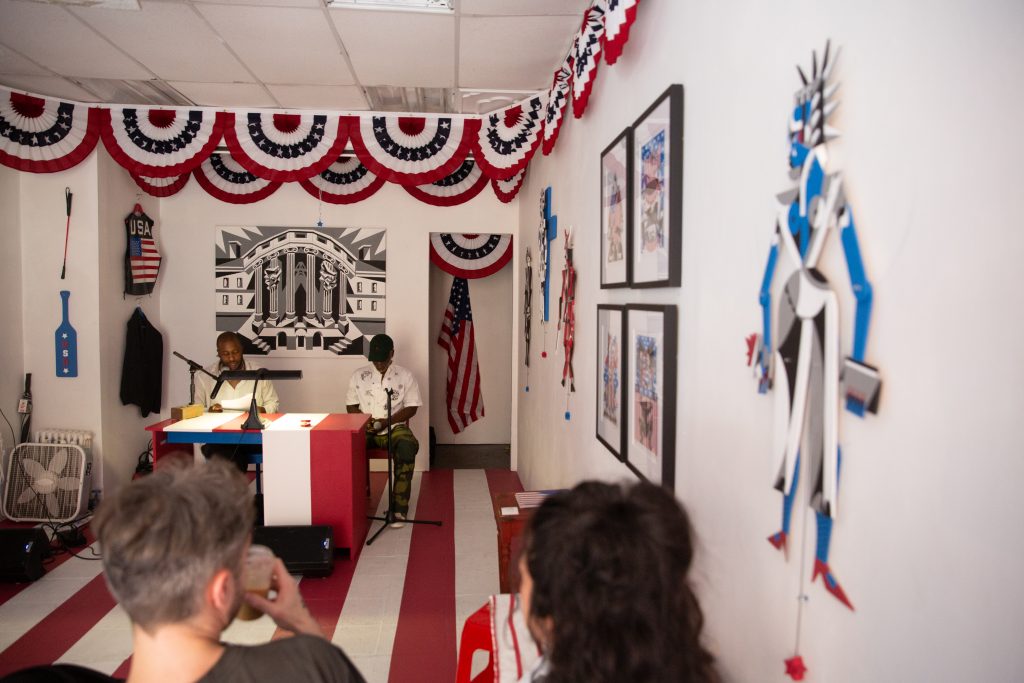
Amongst this collective of young Americans, perhaps the most timely project was Dispatches from the Fourth World, a live conversation series developed by photographer, researcher, and educator Joey Cochran.
Cochran met Bock through Mooncalf, an experimental interdisciplinary curatorial project Bock co-founded with artist Luke Ivy Price and sound artist James Lambros. The project has operated through extended pop-ups in Alphabet City, supporting artists whose practices move between visual art, fashion, film, performance, puppetry and sound. After attending a conversation Cochran led on the deterioration of cultural production amid New York City’s economic decline, Bock invited him to be part of Young Americans.
Dispatches from the Fourth World brings Cochran into live conversation with artists, workers, and other cultural figures creating an archive of the world today. The events are audio recorded and will eventually be transcribed into a book published through Cochran’s imprint, Quartermaster. The word “dispatches” reflects the mobile and site-specific character of the project. Rather than polished studio podcasts, Cochran travels directly into the places being discussed, establishing a platform for open conversation.
“Art is also about ideas,” Cochran said. “We need to bring it back to the ideas as well, or find a balance between ideas and objects. And I think that is done through action.”
“We set up shop wherever we are, and we record, and we talk some shit,” Cochran says. “We get to the brass tacks of what’s going on… I want people to feel they’re a part of the artwork, to feel a part of the final production,” Cochran said. Although objects remain central to art, Cochran argued that cultural production has become too heavily concentrated on the object at the expense of the ideas surrounding it. “Art is also about ideas,” Cochran said. “We need to bring it back to the ideas as well, or find a balance between ideas and objects. And I think that is done through action.”
In Young Americans, that action takes several forms. It is the physical act of pulling a puppet’s strings. It is the social act of joining a conversation. It is the curatorial act of offering space to artists and thinkers whose work does not fit cleanly within existing structures.
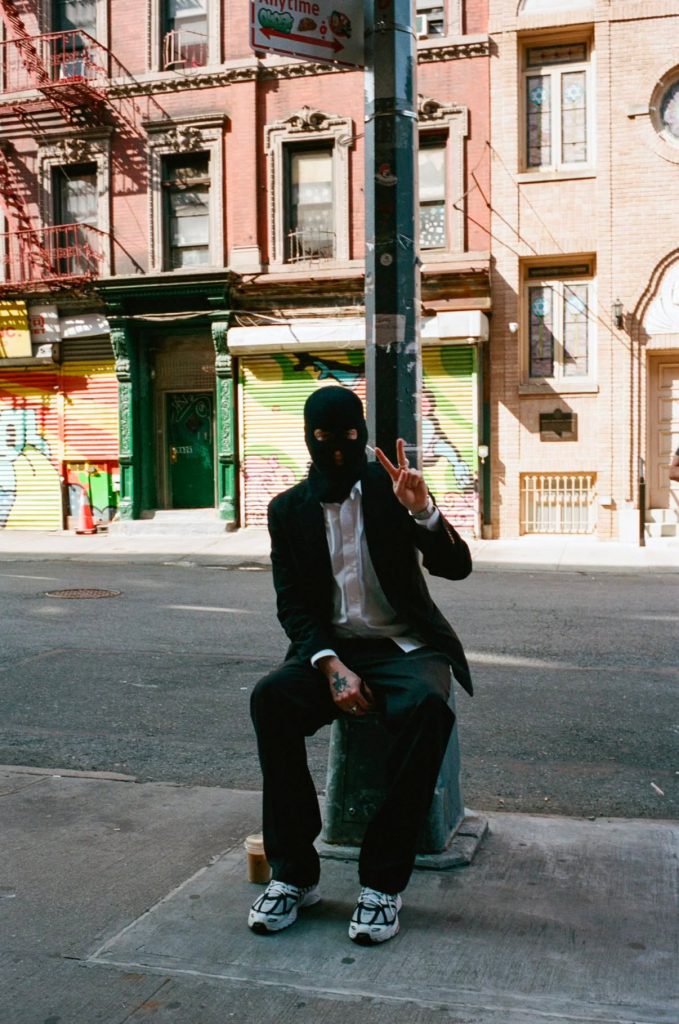
In the 8 years since we met, Bock has grown both as a satirist and as an artist, symbolically taking the shape of a tailored suit. “People take me more seriously now because I’m wearing a suit,” he said. “But I’m really just an artist pretending to be a curator or a dealer.” The shift is part professionalism, part performance and part commentary on perception.
Throughout Young Americans, Bock returns to this tension between appearance and control. The exhibition presents recognizable national symbols, and resembles a celebration, but acts as a warning. The exhibition became a catalyst for conversation and though Young Americans does not dictate a singular political conclusion, it builds a situation in which participation becomes unavoidable. To enter is to move across the flag, confront the puppets, encounter other voices, and consider one’s own relationship to the systems being represented.
The exhibition became a catalyst for conversation and though Young Americans does not dictate a singular political conclusion, it builds a situation in which participation becomes unavoidable.
Looking back on the exhibit, Bock shared, “I couldn’t be happier with how Young Americans played out. From the jump I was determined to treat this exhibition differently; to attempt to create a true communal happening and a cultural hub for exchange of ideas and information between likeminded individuals and groups.”
He continued, “as we all witness the strain on traditional gallery model and art market during this time of political polarization, authoritarian censorship and federal divestment from the arts I can see a real path forward by thinking outside of tradition. There is a real opportunity to rethink the civil utilization of the gallery space and in turn to create new systems to support the arts.”
250 years is young for a nation, and with youth comes the promise of maturity and growth. The symbols may be traditional, the institutions strained and the strings tangled, but Young Americans shows us that the future remains ours to control. Bock doesn’t tell us what America is, but asks us what are we willing to make of it.
T.K. Mills is the Editor-in-Chief of UP Magazine, a street art publication based in New York City. After receiving a Master’s Degree in Global Affairs, he discovered a love for graffiti while backpacking through Cuba and pursued life as a writer. Outside of UP, T.K. enjoys writing poetry, personal travel essays, and occasionally short stories. His work has been published in The Smart Set, The Vignette Review, Genre Urban Arts, and Eternal Remedy among others. Beyond art, T.K. loves reading and traveling.
Insta: @t.k.m85
Website: www.tkmills.com